xblueCamera




When asked to place the pandemic-spurred changes in office design in a
historic context, Guy Leibler, president of Simone Healthcare Development,
immediately settled on 9/11. He was president and chief operating officer of
architecture giant Skidmore Owings & Merrill back then.
The enormous awfulness of that day 19 years ago is, of course, what he
remembers the most, Leibler said. As far as office design, however, he
clearly recalled a sudden shift in his field.
“The practice of architecture quickly pivoted to look at the hardening of
buildings — how to make buildings resistant to terrorism,” Leibler said.
That shift, though profound as it was at the time, has nothing on what’s
happening now, he said. The changes due to 9/11 were fairly narrow in scope
and in geography. The global pandemic has such a larger canvas and reach.
“This is so unique in every which way,” Leibler said. “It affects you and me
from the moment we wake up in the morning to when we get back in our
house.”
The changes to offices and office buildings are, therefore, likely to be deeper
and more enduring than what most real estate owners and tenants — and the
people who work in offices — have ever experienced. The transformation is
in motion, too, as the changes move beyond the speculative to the concrete.
Companies are asking for certain office features, and wary employees are
coming to expect them.
The paradigm has shifted, according to analysts, investors, and owners who
recently spoke with Commercial Observer. Or, to put it more bluntly, the
pandemic has accelerated shifts that were already underway in fits and starts.
Commercial real estate has leaped ahead years in a matter of months.
‘That notion is gone’
“You’re going to look at the decoupling of one person with a seat with their
name on it,” said Rachel Casanova, senior managing director of workplace
innovation at Cushman & Wakefield, about the broad changes in workplace
usage that the pandemic has sped up.
Casanova is among the cohort of experts who have long-reminded office
users and real estate market watchers that companies, generally, don’t use all
of their office space all of the time to begin with — employees vacation, they
go on leave, technology has rendered certain features superfluous or obsolete,
entire rooms and sections sit long vacant, etc.
Changes, even on a grander scale, should not be all that surprising then.
Companies were adjusting their needs long before COVID-19 hit, and owners
and developers have been responding. Also, there was an increasing reliance
on technology to not only streamline the office experience, but to track —
and adjust appropriately — metrics, such as energy use and occupancy levels.
“A lot of what you’re seeing now, and what you’ll see post-COVID, are
really just trends happening already [that] got accelerated,” said Craig
Deitelzweig, CEO of Marx Realty & Improvement Co., an owner and
operator whose New York holdings include 545 Madison Avenue and 430
Park Avenue.
Marx Realty has long provided an app for tenants to ease their employees’
office use, including in entering and exiting, for instance. The app now warns
them if they’re standing too close to someone. Marx also embraced the sort
of brass and copper finishes that turned out to be inhospitable for the
coronavirus, but that the company originally chose because they provided an
inviting look and feel, Deitelzweig said.
So, the biggest change likely to stick around is the idea of change itself.
Workers in major markets, such as New York, Los Angeles and Chicago,
have warmed to flexibility in their work environments, and companies will
increasingly seek such environments that make that flexibility easier to
provide.
“The Future of Workplace,” a Cushman & Wakefield analysis released most
recently in August that included 50,000 respondents, found that 73 percent
expect their companies to offer flexible working practices for the foreseeable
future. The report also found that the future of the office will involve some
sort of balance of 1) work from home; 2) the office itself; and 3) so-called
“third places” between the two, such as coffee shops.
“Before, the presumption was, I have to be in the office, because that’s the
place I get my work done, and things will only work if most of us are there,”
said Aditya Sanghvi, a senior partner at consultancy McKinsey & Co. and coauthor
of the firm’s “Reimagining the office and work life after COVID-19”
report released in June. “That notion is gone.”
In its place will be a change in how companies use their space. That could
lead to significant cost savings for some firms, as the McKinsey report
estimated some could save 30 percent in real estate costs over time. The
change will cement the trend in reconfigurations and adjustments already
underway, as companies align their needs with a post-COVID-19 work
environment of more flexible scheduling and fewer employees in the office at
once.
“What I think is more likely is that we will connect our occupancy strategies
with our behavioral strategies,” Casanova said.
Automatic for the people
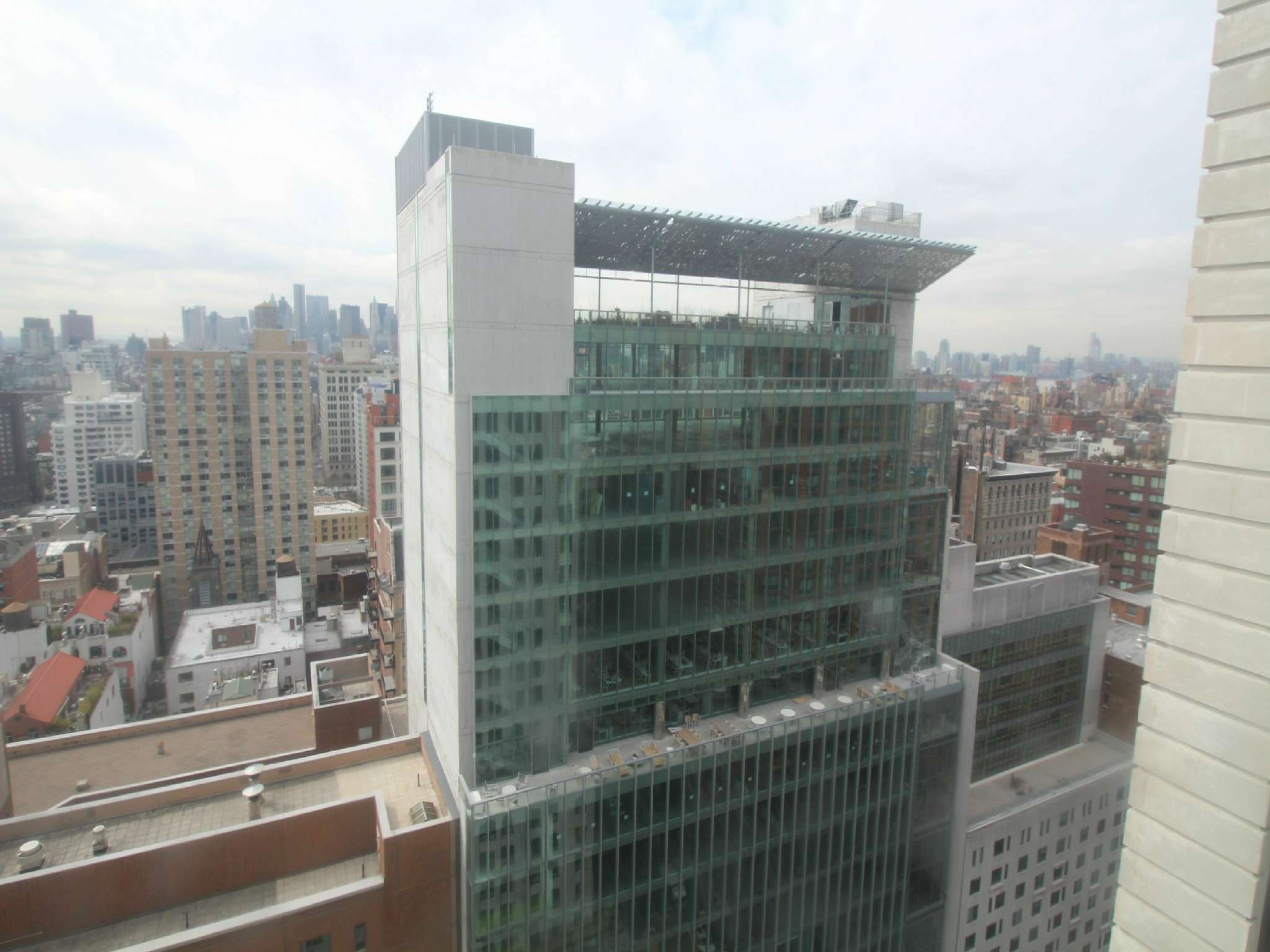
RAL Development Services topped off its Zero Irving building in
Manhattan’s Union Square in September. The 21-story building will include
175,000 square feet of office space available for move-in starting in spring
2021.
The building itself was designed to appeal to increasingly office-influential
technology, advertising, media and information (TAMI) firms with such
features as touchless technology that opens doors, programs elevators, and
takes workers through security via smartphone. Its construction will also
allow for individual floors to have their own air filtration rather than share
with other parts of the building.
In other words, it’s the same sort of features that were already in demand but
are now in higher demand due to the coronavirus. Such amenities are already
increasingly common in office buildings, according to developers and
analysts, but the pandemic solidified demand for them.
“Every tenant that comes to the building, some of them weren’t even thinking
about it,” Josh Wein, RAL’s managing partner for finance, said. “And now,
once they see it, they’re like, ‘that’s amazing; that’s something we definitely
want.’ Other companies are asking about a safe working environment in
general.”
Touchless entry and exit, access to outdoor space and fresh air while indoors,
more space between work areas, and generally fewer desks in favor of more
spaces for collaboration — these are the changes to office space that are most
likely to stick around post-COVID-19, owners and analysts said.
Technology developed pre-pandemic will drive much of this. And this
technology, in turn, will not only streamline employees’ experience, but will
also help office space owners and operators better track those metrics, such as
occupancy and energy use — so that it starts to be a money-saver, as well as
a way to ensure that space is not becoming overcrowded. Tracking of energy
use can also be good for the environment and could aid contact tracing for
COVID-19.
What’s more, it will help companies figure out just how hybrid they can be.
“Once companies figure out how to measure productivity on a week-to-week
basis, then you can pilot new ways of working, new ways of hybrid, and
actually see if it’s a success or not,” Sanghvi said.
Commercial real estate owners can sell the possibility of this data crunch as a
perk of doing business with them as well.
In fact, the owners already embracing such technology are better positioned
than those who aren’t, said Tim Bellman, managing director and head of
global research for Invesco Real Estate. He added that an Invesco analysis
during the pandemic found that such technologically driven changes are most
common in marquee properties that were already driving a tenant experience
pre-pandemic. These properties tended to cluster in TAMI hubs, too.
“I think that the buildings that are well-designed from that perspective will
continue to command tenant loyalty in the period ahead,” Bellman said.
As for more access to outdoor space and to fresh air — or to filtered air that’s
not shared with other tenants on the inside — not every owner will be able to
provide. But owners say such access will be something that more tenants will
want.
“Almost every call I get now includes a question around whether or not the
windows are operable,” said Kathe Chase, leasing director at Industry City.
The Brooklyn office complex carved from an old port and factory site seems
poised to benefit from demand spurred by COVID-19 for not only more
outdoor access, but for the desire for more space in general to put distance
between employees.
That turn toward de-densifying offices is probably the most noticeable
change going forward, but that, too, was around before the pandemic.
For years, it was about piling more workers into the same amount of space or
smaller. Think open offices with employees sitting almost elbow to elbow.
The rule of thumb for the industry in the 1980s was 200 to 300 square feet
per employee, according to Moody’s Analytics. By 2019, it was 126.5 square
feet — and falling.
That sort of density, though, was starting to lose favor pre-pandemic. The
open office, in particular, had started to give way to an emphasis on more
collaborative spaces as well as rotating desk assignments. Industries, such as
law and media, were experimenting with flexible schedules and remote work.
Landlords and major tenants were embracing coworking.
COVID-19 has likely finished off any move to pack in more office workers
that tightly.
‘The next normal’
The work-from-home shift that the coronavirus forced on companies
nationwide has proven largely successful, except for one area, as far as
business executives see things. Surveys regularly return concerns not about
productivity and teamwork, but about fostering company culture when the
majority of employees are remote. Onboarding new hires comes up a lot.
But a de-densified, more flexible workspace doesn’t have to get in the way of
fostering company culture, McKinsey’s Sanghvi said. It’s something he’s
driven home to clients who are often skeptical.
“When you look at what companies say is their culture and values,” he said,
“few of those things actually imply that it has to be in person. Some clients
were surprised about how hybrid can work with their company culture, even
if others found that in-person is critical to their culture.”
And that might be the biggest change of all. As more companies realize the
durability of a more flexible, hybrid model, barriers to the changes propelled
by COVID-19 start to fall. There is the creeping realization that the
alternative to permanent office design changes is that there is no alternative.
However, there are still some agnostics out there. Jeremy Moss, executive
vice president and director of leasing at major downtown Manhattan owner
Silverstein Properties, who has been back at the office for weeks, told CO in
early October that any big office design changes would come “at the
margins.”
“The notion that we’re completely going to do away with office space or it’s
going to look totally different, I think, is a fallacy,” Moss said.
Yet, report after report during the past several months confirm that more
companies in myriad industries are considering continuing to readjust and
pull back on their office needs. COVID-19 appears to have made up their
minds for them.
Eighty-two percent of respondents to a survey of 250 technology companies
by brokerage Savills said they anticipated needing less office space in the
next 12 to 18 months. The survey, “COVID-19 Impacts on the Technology
Industry,” released Oct. 7, found that 55 percent expect to dispose of space
during the same period.
According to Cushman & Wakefield’s latest “Bright Insight: 2020 National
Legal Sector Benchmark Survey,” released in July, 96 percent of respondents
from the 608 law firms and associate participants surveyed anticipated that
their attorneys would work from home more often in the next five years. That
survey was conducted before the start of the pandemic, and the share had
been trending up for a while.
What’s more, such prominent office users as Facebook, Google, Twitter,
Amazon, Wells Fargo, Royal Bank of Scotland, Salesforce and Viacom have
all said that their employees can work from home going into 2021.
Other prominent companies’ office returns have been in fits and starts.
JPMorgan Chase, one of Manhattan’s largest office users and the nation’s
largest bank by assets, brought back employees of its trading and sales
operations beginning in early September — only to send many home after
COVID-19 cases emerged. The bank did not return requests for comment
regarding its own office setup, though CEO Jamie Dimon told a virtual forum
in mid-September that “we’ve got social distancing” in effect in JPMorgan’s
offices as part of other “permanent changes.”
It will be chief executives like Dimon who make the final decision about
office returns, as well as the permanency of office changes, analysts say. But
the demand for more flexible attendance, touchless entry and exit, betterfiltered
air, and far less density is already driving the office market.
Spaces will have to give companies and their employees a reason to be in the
office. Otherwise, why navigate a commute, and perhaps a security clearance,
never mind potential crowds, to simply sit at another table that is not the one
in their kitchen?
As more than one analyst has pointed out, it’s an echo of what happened to
brick-and-mortar retail. Stores that could provide a sort of shopping
experience have been able to hold out more successfully against
e-commerce’s onslaught better than those still simply presenting the same old
options to consumers.
Employees do not want to return to the same old office due to safety reasons
— the Savills survey of tech firms found nearly all expected hybrid
arrangements to become normalized long term — and companies don’t want
to continue to pay for configurations and footprints that weren’t necessarily
meeting their needs even before the pandemic.
It’ll be up to asset managers, including owners, to react until that apparently
still-distant day when a vaccine, perhaps, settles things. By then, what
Simone’s Leibler calls “the next normal” will be in place, and the office
environment pre-pandemic will be, in whole parts, gone.
“This is historic in so many ways,” he said.